
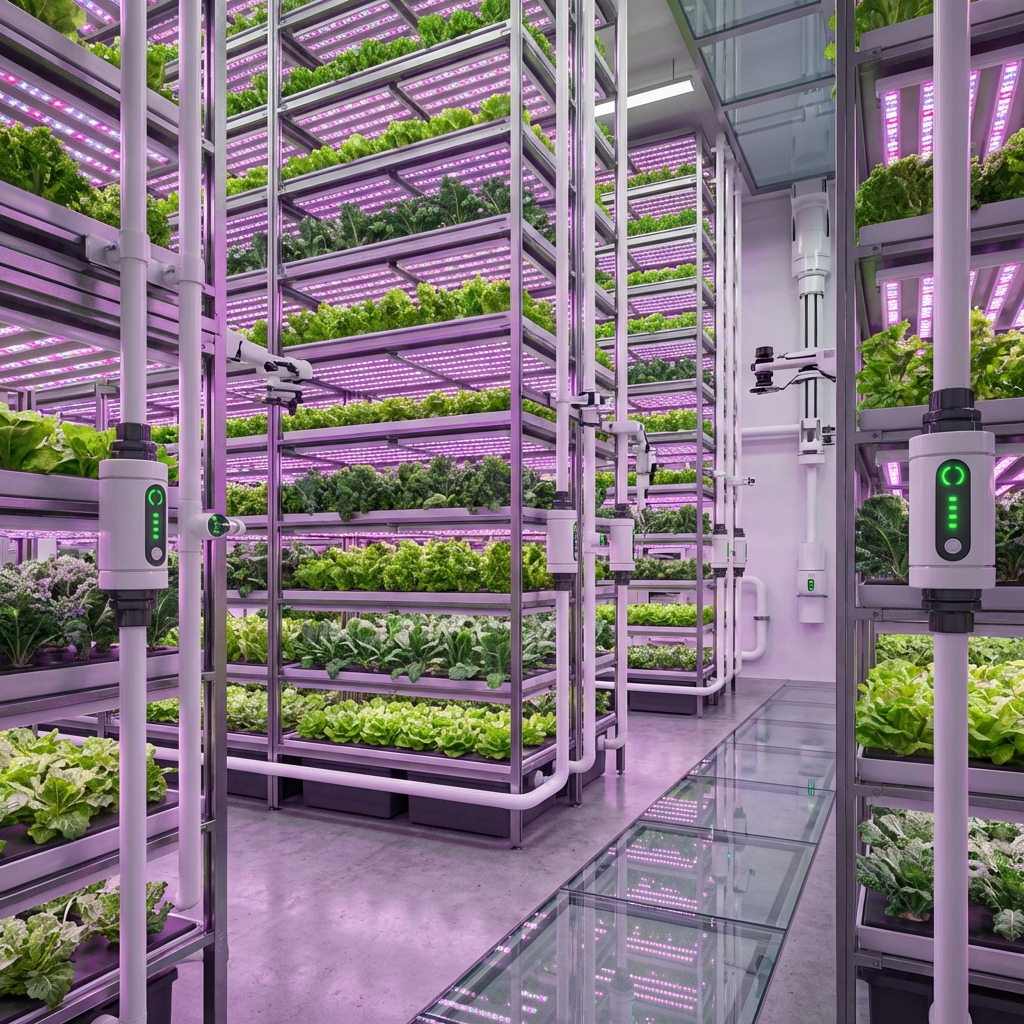
The global population will reach 9.7 billion by 2050, requiring food production to increase by 70% while cultivable land shrinks and climate change intensifies. Traditional agriculture faces insurmountable constraints: water scarcity, soil degradation, transportation costs, and environmental impact.
The solution? Vertical farming—stacked layers of crops grown indoors under precisely controlled conditions. These facilities can produce 350 times more food per acre than traditional farming, use 95% less water, eliminate pesticides, and operate adjacent to urban centers, slashing transportation emissions.
But vertical farming's promise depends on solving a critical infrastructure challenge: how do you efficiently power and control hundreds or thousands of precise irrigation points across multi-level growing operations?
The answer is elegant and transformative: Power-over-Ethernet (PoE) technology, traditionally used in IT networks, is now revolutionizing agricultural automation.
The Vertical Farming Imperative
Vertical farming addresses multiple existential challenges facing global food systems:
Land Scarcity
With urbanization accelerating and agricultural land converting to development, traditional farming faces spatial constraints. Vertical farms stack growing layers, achieving production densities impossible with conventional agriculture. A single acre of vertical farming can produce yields equivalent to 350 acres of traditional farmland.
Water Conservation
Agriculture consumes 70% of global freshwater. Vertical farms use hydroponic, aeroponic, or aquaponic systems that recirculate water, reducing consumption by 95% compared to field agriculture. This makes food production viable even in water-stressed regions.
Climate Resilience
Droughts, floods, extreme temperatures—climate change is destabilizing traditional agriculture. Vertical farms operate in controlled environments, immune to weather variability. Year-round production eliminates seasonal limitations.
Pesticide Elimination
Enclosed environments exclude pests, eliminating pesticide requirements. The result: cleaner, safer produce with longer shelf life.
Urban Proximity
Vertical farms can locate within cities, near consumers. This proximity slashes transportation costs, reduces spoilage, and cuts food miles—the distance food travels from farm to table. Urban vertical farms deliver fresher produce while minimizing carbon emissions from transportation.
The Infrastructure Challenge
Despite these advantages, vertical farming faces a critical bottleneck: infrastructure complexity.
A typical vertical farm might contain:
- Hundreds of growing towers or racks
- Thousands of plant positions requiring individual irrigation
- Precise nutrient delivery systems
- Environmental control (temperature, humidity, CO₂, light)
- Monitoring sensors tracking plant growth and health
Traditional irrigation approaches create nightmares of complexity:
Conventional Pumps: Each pump requires separate electrical wiring and control cabling. For a facility with 200 irrigation points, that means 400+ cable runs—immense installation cost, maintenance complexity, and failure points.
Centralized Systems: Using fewer, larger pumps with distribution networks creates efficiency losses, pressure inconsistencies, and reduced control precision. You can't optimize flow for individual plant needs.
Manual Control: Without automated adjustment, operators manually regulate irrigation schedules and flow rates—labor-intensive, imprecise, and unable to respond dynamically to plant needs.
The solution requires:
- Distributed control—individual pump management for precision
- Simplified installation—minimal cabling complexity
- Centralized intelligence—AI-driven optimization across the entire system
- Energy efficiency—reducing operational costs
- Scalability—easy expansion as facilities grow
Enter Power-over-Ethernet.
PoE: The Perfect Agricultural Solution
Power-over-Ethernet was developed for IT networks, enabling a single Ethernet cable to deliver both data connectivity and electrical power. PoE powers devices like VoIP phones, security cameras, and wireless access points—eliminating the need for separate power supplies.
The same technology transforms agricultural automation:
Single Cable Infrastructure: One Ethernet cable per pump delivers both power (up to 90W with PoE++) and bidirectional data communication. Installation complexity drops dramatically.
Centralized Intelligence: All pumps connect to network switches linked to farm management software. A single control system manages hundreds of pumps, monitoring performance, adjusting flow rates, and coordinating nutrient delivery.
Precise Control: Each pump operates independently based on real-time data: plant growth stage, soil moisture (if used), environmental conditions, and nutrient requirements. This precision is impossible with centralized systems.
Energy Efficiency: PoE pumps operate at low voltage (48V DC), converted efficiently by modern switch-mode power supplies. Combined with intelligent on-demand operation, energy consumption drops 30-40% compared to conventional always-on AC pumps.
Safety: Low-voltage DC operation is inherently safer than high-voltage AC, particularly in humid agricultural environments.
Scalability: Adding capacity means installing additional PoE switches and pumps—simple, modular expansion without major electrical work.
AgriPro®: PoE Smart Pumps
At Smartricity, our AgriPro® product line embodies the convergence of motor technology and agricultural intelligence:
Hardware Design
AgriPro® pumps are engineered specifically for vertical farming:
- PoE Power: IEEE 802.3bt compliant, supporting up to 90W for high-flow applications
- Precision Flow Control: Variable speed motors with feedback control maintain exact flow rates regardless of pressure variations
- Corrosion Resistance: Food-grade materials resist nutrient solution chemistry
- Compact Form Factor: Space-efficient design fits tight growing infrastructure
- Field Serviceable: Modular construction enables quick replacement of wear components
Intelligent Control
Beyond hardware, AgriPro® pumps integrate sophisticated software:
Real-Time Adaptation: Pumps adjust flow rates based on:
- Plant growth stage (seedling, vegetative, flowering, harvest)
- Time of day (coordinating with lighting cycles)
- Environmental conditions (temperature, humidity affecting water uptake)
- Nutrient concentration requirements
Predictive Optimization: AI algorithms learn optimal irrigation patterns from historical data, continuously refining delivery schedules to maximize crop yields while minimizing water and nutrient consumption.
Anomaly Detection: Continuous monitoring identifies problems early:
- Clogged emitters reducing flow
- Pressure variations indicating system issues
- Pump performance degradation signaling maintenance needs
- Leak detection from unexpected flow patterns
Energy Management: Intelligent scheduling shifts non-critical irrigation to off-peak electricity hours, reducing energy costs. Coordinated startup prevents simultaneous pump activation that would spike electrical demand.
System Integration
AgriPro® pumps don't operate in isolation—they integrate with comprehensive farm management platforms:
- Environmental Control: Coordination with HVAC, CO₂ injection, and lighting systems
- Nutrient Management: Automated mixing and delivery of fertilizer solutions
- Growth Tracking: Integration with camera systems and sensors monitoring plant development
- Analytics Dashboard: Real-time visibility into water usage, energy consumption, system health, and crop performance
This integration transforms vertical farming from labor-intensive manual management to autonomous, optimized operations.
The Economic Case
PoE irrigation delivers compelling economics:
Infrastructure Savings
Traditional irrigation in a 50,000 sq ft vertical farm might require:
- 300 individual pump installations
- 600 cable runs (power + control)
- Multiple electrical panels and circuit protection
- Complex conduit systems
- Extensive installation labor
Installation Cost: $180,000-$250,000
PoE infrastructure for the same facility:
- 300 PoE pumps
- 300 Ethernet cables
- PoE switches with management capabilities
- Network configuration
Installation Cost: $90,000-$130,000
Savings: $90,000-$120,000 (40-50% reduction)
Operational Savings
Energy Efficiency: PoE pumps consume 30-40% less energy than conventional alternatives. For a facility using 200 MWh annually for irrigation:
- Energy savings: 60-80 MWh/year
- Cost savings (at $0.12/kWh): $7,200-$9,600/year
Labor Reduction: Automated control eliminates manual irrigation management. Labor savings of 15-20 hours/week for a mid-sized facility translates to $15,000-$25,000 annually.
Water Optimization: Precise delivery reduces water waste by 10-15%, saving thousands of dollars annually in water costs while improving crop quality through optimal hydration.
Yield Improvements
The most significant economic impact comes from optimized growing conditions:
Faster Growth: Precise nutrient and water delivery accelerates crop development, reducing days to harvest by 5-10%
Higher Quality: Consistent environmental control produces premium crops commanding higher prices
Reduced Waste: Minimized crop loss from under/over-watering or nutrient imbalances
For a facility producing $2 million in annual revenue, even a 5% yield improvement adds $100,000 to top-line revenue—with minimal additional cost.
Environmental Impact
Beyond economics, PoE irrigation advances sustainability:
Water Conservation: Precision delivery eliminates runoff and waste. Combined with closed-loop recirculation, vertical farms achieve 95%+ water use efficiency compared to traditional agriculture.
Energy Efficiency: Lower power consumption directly reduces carbon emissions. A 40% reduction in irrigation energy consumption for a facility using 200 MWh annually prevents approximately 60 tons of CO₂ emissions yearly (assuming grid average emissions).
Nutrient Optimization: Precise delivery prevents nutrient runoff that pollutes waterways in traditional agriculture. Controlled environment agriculture has zero agricultural runoff.
Reduced Food Miles: Urban vertical farms supplying local markets eliminate transportation emissions. A facility serving a metro area can prevent thousands of tons of CO₂ from long-distance food transport.
The Future of Agriculture
Vertical farming is no longer experimental—it's scaling rapidly:
- The global vertical farming market is projected to reach $33.02 billion by 2030
- Major operators are building facilities exceeding 100,000 sq ft
- Retailers are investing directly in controlled environment agriculture
- Technology costs continue falling, improving economic viability
PoE irrigation infrastructure is enabling this scale-up. The technology that powers modern IT networks is now powering the farms feeding future generations.
As climate pressures intensify, as urbanization continues, and as food security concerns grow, vertical farming will transition from niche alternative to agricultural mainstream. The infrastructure supporting this transition—smart, efficient, scalable—will determine which operations succeed.
Powering the Future of Food
The convergence of PoE technology and agricultural innovation represents more than incremental improvement—it's a fundamental reimagining of how we produce food.
Traditional agriculture evolved over millennia. Vertical farming, optimized by intelligent automation, achieves in months what took generations to develop. The result: more food, using less water, on less land, with lower environmental impact—all enabled by the intelligent infrastructure that makes precision agriculture possible.
AgriPro® PoE smart pumps don't just deliver water. They deliver the infrastructure making sustainable, scalable, urban agriculture viable. They're powering the future of food.