
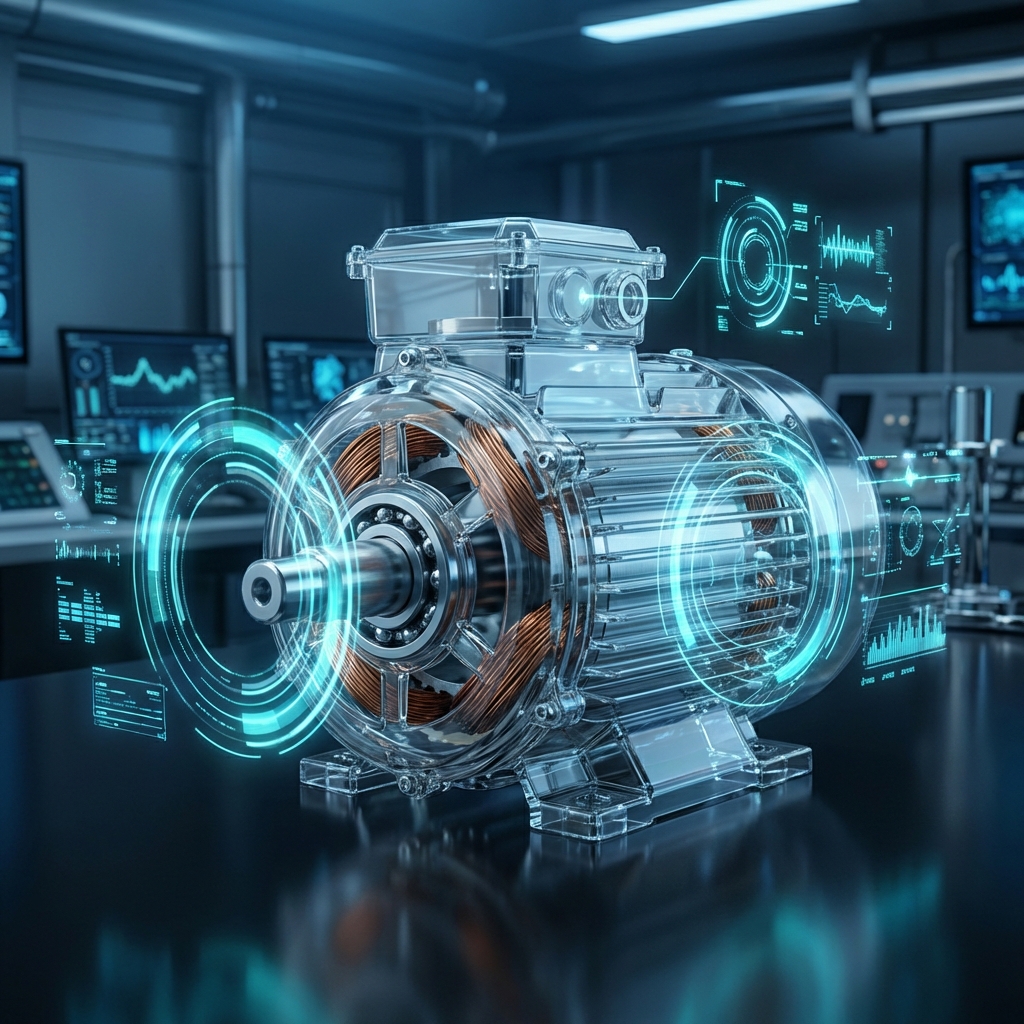
Consider how predictive maintenance plays out on the ground. In the early hours of the morning, an algorithm notices something troubling in a motor driving a critical process. To human observers, nothing appears wrong. The motor is running smoothly, temperature gauges show normal readings, and no unusual noises emanate from the equipment.
But the AI sees something different.
Buried in the vibration data — thousands of measurements per second, more than a human could possibly process — subtle frequency components are rising at characteristic bearing-defect frequencies. The amplitude is still small, barely above background noise. But the trend is unmistakable, and the algorithm has seen this pattern before.
Diagnosis: bearing outer race defect, early stage.
Predicted time to failure: roughly 4–6 weeks.
Recommended action: schedule bearing replacement during the next planned maintenance window.
The maintenance team orders replacement bearings, schedules a service window, and replaces the bearing without disrupting operations. Post-service inspection confirms the algorithm's diagnosis: the outer race shows early spalling — surface cracks that would have propagated rapidly, leading to catastrophic failure within weeks.
Cost of a planned bearing replacement: a few thousand dollars plus a
few hours of scheduled downtime.
Cost of a prevented catastrophic failure: often hundreds of thousands — sometimes more — in
emergency repairs and unplanned production losses.
This is predictive maintenance in action.
Beyond Human Perception
Humans are remarkably poor at detecting early-stage equipment failures. Our senses aren't designed for it:
- We can't hear ultrasonic frequencies where bearing defects first manifest
- We can't see internal thermal patterns indicating insulation degradation
- We can't process thousands of data points simultaneously to identify subtle trends
- We're biased by recent experience, missing gradual changes that develop over months
Electric motors fail through well-understood physical processes: bearing wear, insulation breakdown, rotor bar cracks, misalignment, lubrication degradation. Each failure mode produces characteristic signatures—changes in vibration, temperature, electrical current, acoustic emissions—long before catastrophic failure occurs.
The challenge isn't physics—it's detection. These early warning signs are often invisible to human operators. By the time failures become obvious (loud noises, excessive heat, burning smells), damage is severe and options are limited.
AI-powered predictive maintenance solves this problem by monitoring equipment continuously, analyzing vast data streams, and detecting anomalies invisible to human perception.
The Sensor Array
Modern intelligent motor systems incorporate comprehensive sensor suites:
Vibration Sensors
Accelerometers mounted on motor housing and bearing assemblies measure vibration in three axes. Sampling rates of 10,000-25,000 Hz capture detailed signatures of rotating machinery.
Vibration analysis is the workhorse of predictive maintenance because nearly every mechanical fault produces distinctive vibration patterns:
Bearing Defects: Bearings have four primary failure modes, each with characteristic vibration frequencies:
- Outer race defects: Vibration at ~3.6x shaft speed
- Inner race defects: ~5.4x shaft speed
- Ball/roller defects: ~2.8x shaft speed
- Cage defects: ~0.4x shaft speed
As defects develop, vibration amplitude at these frequencies increases predictably. AI monitors these specific frequency bands, detecting rising amplitudes weeks before failure.
Imbalance: Unbalanced rotors produce vibration at exactly 1x shaft rotation frequency. The amplitude indicates severity; the phase indicates where mass should be added or removed.
Misalignment: Angular or parallel misalignment creates vibration at 2x and 3x shaft frequency, with characteristic axial components.
Looseness: Mechanical looseness produces subharmonic vibrations at 0.5x, 1.5x, and 2.5x shaft frequency.
Each fault has a unique vibration signature. AI algorithms trained on thousands of historical failures recognize these patterns instantly.
Thermal Sensors
Temperature monitoring tracks motor health through multiple sensors:
- Winding Temperature: Embedded thermocouples or RTDs measure stator winding temperature directly
- Bearing Temperature: Sensors at each bearing assembly detect excessive friction
- Ambient Temperature: Reference measurement for load compensation
- Surface Temperature: Thermal imaging (where deployed) maps surface temperature distribution
Thermal analysis reveals:
Insulation Degradation: Gradual temperature increase under consistent loads indicates insulation breakdown, reducing thermal conductivity and increasing resistance.
Bearing Problems: Rising bearing temperature indicates lubrication failure or excessive friction from wear.
Ventilation Blockage: Higher overall temperatures with normal load suggest impaired cooling from blocked ventilation or fan failure.
Overloading: Temperature rise correlated with increased load is expected, but sustained overloading accelerates aging.
AI thermal models learn each motor's normal thermal behavior—how quickly it heats during startup, its steady-state temperature profile at various loads, cooling curves during shutdown. Deviations from these learned patterns trigger investigations.
Current Sensors
Electrical current contains surprising amounts of information about mechanical condition through a technique called Motor Current Signature Analysis (MCSA).
The current supplying a motor should be a clean sine wave (for AC motors) or steady DC (for DC motors). But mechanical and electrical faults create characteristic distortions:
Broken Rotor Bars: Cause sidebands in the current spectrum at slip frequency intervals around the fundamental frequency. As bars crack, these sidebands grow.
Eccentricity: Air gap variations from rotor eccentricity create current modulation at twice slip frequency.
Load Variations: Cyclical loads (pumps, compressors) create characteristic current patterns. Changes indicate mechanical wear or process issues.
Electrical Faults: Turn-to-turn shorts, ground faults, and supply imbalances all produce distinctive current signatures.
MCSA is particularly valuable because it's non-invasive—requiring no sensors installed on the motor itself—and can detect problems (like broken rotor bars) invisible to other techniques.
Additional Sensors
Advanced installations may include:
- Acoustic Emission: Ultrasonic sensors detecting high-frequency sounds from crack propagation, friction, and mechanical impacts
- Oil Analysis (for lubricated systems): Automated sampling and analysis of lubricant condition, particle counts, and contamination
- Position/Speed Sensors: Precise tracking of shaft position and rotational velocity, revealing bearing play and synchronization issues
The AI Advantage
Raw sensor data is valuable only when analyzed intelligently. This is where AI transforms predictive maintenance.
Pattern Recognition
Traditional vibration analysis required experts interpreting FFT (Fast Fourier Transform) spectra—identifying specific frequency components and comparing amplitudes to baselines. This expertise took years to develop and was inconsistently applied.
Machine learning models trained on historical failure data automate this expertise. The AI has "seen" thousands of bearing failures, hundreds of rotor bar cracks, and countless cases of misalignment. It recognizes the early warning patterns instantly and with 90%+ accuracy.
Multi-Variable Analysis
Equipment failures rarely produce single indicators. A bearing defect might show:
- Rising vibration at characteristic frequencies
- Increasing bearing temperature
- Changes in acoustic emissions
- Altered current signatures from mechanical loading variations
AI analyzes all these variables simultaneously, identifying correlated changes that confirm diagnosis. This multi-variable approach dramatically reduces false positives—alerts that trigger unnecessary maintenance—while catching real problems early.
Trend Analysis
The absolute value of a measurement is less important than its trend. A bearing might show vibration levels within acceptable limits, but if amplitude has doubled in the past month, failure is approaching.
AI continuously tracks trends across all monitored parameters, detecting gradual changes invisible in single measurements. Time-series analysis reveals whether conditions are stable, improving, or degrading—and how quickly.
Failure Prediction
The holy grail of predictive maintenance: estimating when failure will occur.
This is possible because most failure mechanisms follow predictable degradation curves. Bearing spalling accelerates exponentially—once initiated, defects grow rapidly. Insulation degradation follows well-understood thermochemical processes. Fatigue crack propagation obeys fracture mechanics.
By modeling these degradation processes and fitting them to observed data, AI predicts remaining useful life with remarkable accuracy. For bearing defects, predictions within ±1 week at 4-8 week forecast horizons are common.
Adaptive Learning
Perhaps most powerful: AI models improve continuously. Every failure—whether predicted or not—becomes training data, refining algorithms and improving future predictions.
Fleet-level learning is particularly valuable. When any individual motor fails in a specific way, the algorithm learns not just about that unit but about all similar motors in similar applications. Patterns invisible in single-asset data emerge when analyzing hundreds or thousands of motors.
What AI Sees: Failure Modes Revealed
Let's examine specific failure modes and what AI detects:
Bearing Outer Race Defect
Physical Process: Contact stress between rolling elements and races causes surface fatigue. Micro-cracks form, leading to spalling—flaking of surface material. As spalling progresses, defects grow, increasing vibration and friction.
AI Detection:
Week 1-4: Slight increase in vibration at bearing defect frequency (6.2x shaft speed), amplitude
still within normal range
Week 5-6: Amplitude crosses threshold, AI flags developing problem
Week 7-8: Exponential growth begins, time-series model predicts failure in 4-6 weeks
Week 9-12: If not addressed, catastrophic failure occurs
Advance Warning: 4-8 weeks
Prevention Window: 6-10 weeks from initial detection to optimal replacement
timing
Stator Winding Insulation Failure
Physical Process: Thermal cycling, contamination, and voltage stress degrade insulation. Resistance decreases, leakage current increases, hot spots develop. Eventually, turn-to-turn shorts or ground faults occur.
AI Detection:
Month 1-3: Gradual increase in winding temperature under consistent loads, thermal model detects
deviation
Month 4-6: Insulation resistance testing (if performed) shows degradation
Month 7-9: Current signature shows increasing harmonic distortion
Month 10-12: Without intervention, short circuit and catastrophic failure
Advance Warning: 3-6 months
Prevention Window: Extended timeline allows planned replacement during annual
maintenance
Rotor Bar Crack
Physical Process: Thermal expansion, starting current stress, and mechanical vibration create fatigue in rotor bars. Cracks initiate and propagate until bars fracture completely.
AI Detection:
Week 1-8: MCSA detects emerging sidebands at slip frequency intervals
Week 9-16: Sideband amplitude increases, indicating crack propagation
Week 17-24: Vibration increases as magnetic asymmetry grows
Week 25+: Complete fracture causes severe vibration and potential secondary damage
Advance Warning: 3-6 months
Prevention Window: Sufficient time for rotor rewinding or replacement planning
Misalignment
Physical Process: Improper coupling alignment creates radial and axial forces, accelerating bearing wear and creating excessive vibration.
AI Detection:
Immediately: Vibration at 2x and 3x shaft frequency, particularly in axial direction
Week 1-4: Bearing temperature begins rising from additional load
Week 5-12: Bearing condition degrades, vibration increases exponentially
Advance Warning: Immediate detection, but
consequences develop over weeks
Prevention Window: Alignment correction before bearing damage occurs
The Economic Impact
The business case for AI-powered predictive maintenance rests on the scenario described earlier: catching problems early, avoiding catastrophic failures, and maintaining planned maintenance schedules.
Cost Comparison
Traditional Reactive Maintenance:
- Emergency repair costs: 3x planned maintenance (expedited parts, overtime labor, contractor premiums)
- Unplanned downtime: $25,000-$2,300,000 per hour depending on industry
- Secondary damage: Failed motor often damages connected equipment
- Total cost per major failure: $100,000-$5,000,000
Traditional Preventive Maintenance:
- Scheduled replacement based on calendar/runtime regardless of condition
- Unnecessary work replacing components with remaining life
- Labor costs for frequent inspections
- Total cost: 15-30% higher than optimal
AI Predictive Maintenance:
- Planned interventions during scheduled downtime
- Replace only components approaching end of useful life
- Minimal labor for automated monitoring
- Total cost: 25-30% lower than preventive, 60-80% lower than reactive
Typical Outcomes
Organizations running mature AI predictive-maintenance programs commonly see:
- Meaningful reductions in unplanned downtime: Most developing failures are caught and addressed before they cause shutdowns
- Lower maintenance costs: Condition-based interventions replace blanket preventive work, trimming unnecessary service
- Higher failure-prediction accuracy: Multi-sensor analysis outperforms single-channel condition monitoring
- Strong ROI: Avoided downtime typically dwarfs the cost of sensors, edge compute, and software over a multi-year horizon
For a facility carrying seven- or eight-figure annual downtime losses, even a modest reduction in unplanned outages can fund an entire predictive-maintenance program many times over in the first year.
Implementation: From Data to Action
Effective predictive maintenance requires more than algorithms—it requires process:
1. Baseline Establishment
New monitoring systems learn normal behavior for each motor. This takes 30-90 days of operation across varying load conditions to establish baseline signatures.
2. Anomaly Detection
Once baselines exist, algorithms continuously compare current data to expected behavior, flagging deviations for analysis.
3. Diagnosis
When anomalies are detected, AI classifies the probable failure mode based on signature characteristics. Confidence levels indicate diagnostic certainty.
4. Prognosis
For confirmed developing failures, time-series models predict remaining useful life, enabling maintenance scheduling.
5. Prescription
The system recommends specific actions: "Replace bearing during next scheduled outage" or "Investigate cooling system airflow restriction."
6. Feedback Loop
Actual outcomes—whether predicted failures occurred, whether interventions were successful—feed back into the AI, improving future predictions.
Challenges and Limitations
AI predictive maintenance isn't magic. Limitations include:
Data Quality Requirements: Models need clean, consistent data. Sensor failures, network dropouts, or calibration issues degrade predictions.
Novel Failure Modes: AI trained on historical failures may miss completely new failure mechanisms it's never encountered.
False Positives: Overly sensitive systems generate alerts for non-critical anomalies, creating "alarm fatigue" where operators ignore warnings.
Rapid Failures: Some catastrophic failures (foreign object ingestion, supply voltage spikes) happen too fast for prediction.
Implementation Costs: Retrofitting comprehensive sensor arrays and AI systems to existing facilities requires capital investment and integration effort.
Despite these challenges, the technology is proven and deployed across industries.
The Future: Autonomous Maintenance
The next evolution: fully autonomous maintenance systems that don't just predict failures but automatically respond:
- Ordering replacement parts when degradation detected
- Scheduling maintenance windows and coordinating contractor availability
- Adjusting operating parameters to extend component life until planned service
- Coordinating across multiple assets to optimize facility-wide maintenance
This autonomous future is already emerging in advanced installations. The vision: maintenance teams managing strategic decisions while AI handles routine monitoring, prediction, and scheduling.
Seeing the Invisible
Predictive maintenance powered by AI represents a fundamental shift from reactive to proactive operations. Motors no longer fail unexpectedly—they signal impending problems weeks in advance, enabling planned interventions that prevent catastrophic breakdowns.
The technology transforms maintenance from art to science, from experience-based intuition to data-driven certainty. What AI "sees" in vibration signatures, thermal patterns, and current spectra is invisible to human operators but utterly clear to trained algorithms.
The motor in that scenario didn't fail. And hundreds like it don't fail every day — because AI sees what's coming and gives operators time to act. That's predictive maintenance in action.