
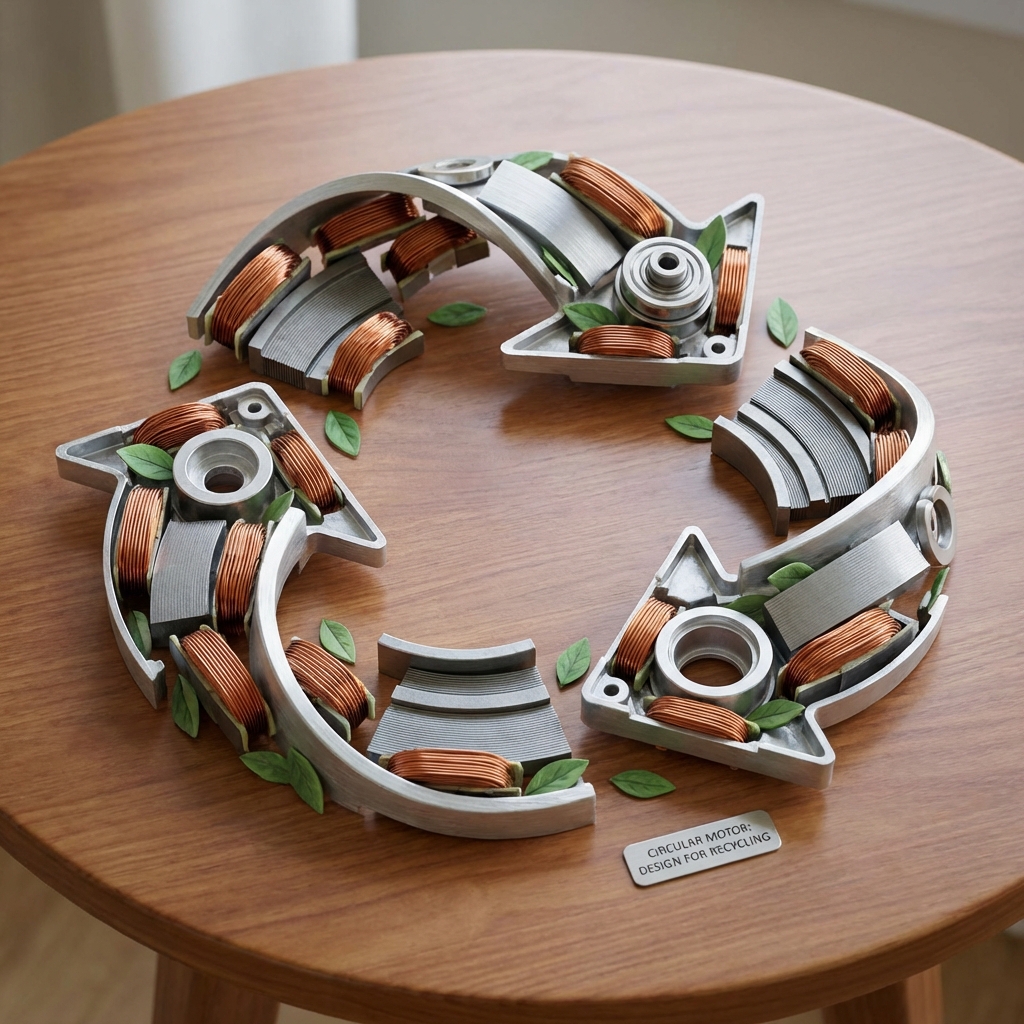
For over a century, the industrial economy has operated on a linear model: extract raw materials, manufacture products, use them, and dispose of them when they fail or become obsolete. This "take-make-dispose" approach seems logical—even inevitable—when virgin materials are cheap, energy is abundant, and landfill space is available.
But that world is ending. Raw material costs are rising. Energy prices are volatile. Environmental regulations are tightening. And the scale of resource consumption required to sustain current industrial production is simply unsustainable.
Consider electric motors: we manufacture over 15 million units daily worldwide. Each requires copper, steel, aluminum, rare earth magnets (for PM motors), insulation materials, and energy-intensive processing. After 5-15 years of service, most motors are scrapped—their embedded materials and embodied energy wasted.
As motor production scales to support electrification, renewable energy, and industrial automation, this linear model becomes economically and environmentally untenable. The alternative—a circular economy where motors are designed for longevity, serviceability, remanufacture, and material recovery—isn't just more sustainable. It's increasingly competitive.
The Linear Economy Problem
The traditional motor lifecycle follows a simple path:
1. Extraction: Mining iron ore, copper ore, bauxite (aluminum), rare earth elements. Energy-intensive, environmentally destructive processes.
2. Processing: Refining ores into metals. Smelting, electrolysis, chemical processing—consuming enormous energy and generating emissions.
3. Manufacturing: Machining steel housing, winding copper coils, assembling components. Embodied carbon for a 100 kW motor: 800-1,200 kg CO₂e.
4. Use: Motor operates for design life—5-15 years depending on application and quality.
5. Disposal: Motor reaches end-of-life through failure, obsolescence, or replacement. Options:
- Landfill: Complete waste of embedded materials and embodied energy
- Low-Quality Recycling: Shredding and metal recovery, but value destruction compared to remanufacture
- Second-Hand Market: Inefficient motors sold to developing markets, perpetuating low efficiency
This linear model creates multiple problems:
Resource Depletion: Continuous extraction depletes finite resources. Copper, rare earths, and specialty steels face supply constraints as demand grows.
Environmental Impact: Mining and processing generate enormous carbon emissions, water pollution, and ecosystem destruction. Copper smelting alone accounts for substantial industrial emissions.
Embodied Energy Waste: A 100 kW motor contains 800-1,200 kg CO₂e of embodied carbon. Disposing of it wastes this energy, requiring new motors to absorb equivalent manufacturing emissions.
Economic Inefficiency: Extracting virgin materials when perfectly good materials exist in end-of-life equipment is economically wasteful, especially as material costs rise.
Supply Chain Vulnerability: Dependence on virgin material extraction creates exposure to supply disruptions, price volatility, and geopolitical risks (particularly for rare earths).
The Circular Economy Alternative
Circular economy principles flip this model. Rather than a linear flow from extraction to disposal, materials and products circulate through multiple use cycles, extracting maximum value before eventual material recovery.
For electric motors, circular economy strategies include:
1. Design for Longevity
The first principle of circular economy: extend product life. Motors lasting 15 years rather than 5 reduce manufacturing demand by 67%—and avoid associated environmental and economic costs.
Longevity design includes:
Robust Construction:
- High-quality materials and components
- Conservative design margins preventing overstress
- Corrosion-resistant materials for harsh environments
- Proper thermal management minimizing degradation
Application-Specific Optimization:
- Motors designed for actual operating conditions rather than generic specifications
- Environmental protection matched to exposure
- Duty cycle optimization preventing accelerated wear
Predictive Maintenance:
- Integrated sensors and AI detecting developing problems
- Early intervention preventing cascading failures
- Condition-based replacement rather than premature disposal
At Smartricity, application-specific design routinely doubles motor service life from 5-7 years (generic motors in harsh applications) to 10-15 years (purpose-built systems). This longevity is the foundation of circularity.
2. Design for Serviceability
Even well-designed equipment requires maintenance. Circular design prioritizes repairability rather than disposability.
Modular Construction:
- Bearings, seals, and wear components designed for replacement
- Standardized interfaces enabling field service
- Subassemblies that can be swapped without full motor replacement
Field-Serviceable Components:
- Bearings accessible without complete disassembly
- Seals replaceable with common tools
- Winding configurations enabling rewinding vs. replacement
- Connectors and harnesses using standard interfaces
Documentation and Support:
- Detailed service manuals with exploded diagrams
- Parts availability throughout product life
- Technical support for troubleshooting and repair
This serviceability transforms minor failures from disposal events into routine maintenance, extending equipment life substantially.
3. Remanufacturing
When motors eventually require major service, remanufacturing offers an alternative to replacement:
Remanufacturing Process:
- Complete disassembly to component level
- Cleaning, inspection, and testing of all parts
- Replacement of worn components (bearings, seals, insulation)
- Reassembly to original specifications
- Full testing and validation
- Warranty equivalent to new equipment
Remanufacturing Benefits:
- Energy Savings: 80% less energy than manufacturing new motors
- Material Savings: 85% fewer virgin materials required
- Cost: 50-70% of new motor price
- Performance: Equivalent to new equipment
- Carbon: Dramatically lower embodied carbon
Leading manufacturers like ABB have pioneered motor remanufacturing programs. ABB's take-back initiative, operating in countries including the Netherlands and Switzerland with plans to expand to 10 more countries, demonstrates the business viability of circular motor economy.
Why Remanufacturing Works for Motors:
- Durable core components (housing, shaft, rotor laminations) rarely fail
- Wear occurs in replaceable parts (bearings, insulation, seals)
- Technology evolution is slow enough that remanufactured motors remain current
- High value of motors justifies remanufacturing economics
For customers, remanufactured motors offer economic and sustainable alternatives to new equipment. For manufacturers, remanufacturing creates service revenue, customer relationships, and differentiation.
4. Material Recovery and Recycling
Even with longevity, serviceability, and remanufacturing, motors eventually reach true end-of-life. At this point, material recovery becomes essential.
Electric Motor Material Composition:
- Steel (housing, shaft, laminations): 50-65% by weight
- Copper (windings): 15-25%
- Aluminum (housing for some motors, rotor bars): 5-15%
- Rare Earth Magnets (PM motors): 1-5%
- Insulation, plastics, other: Balance
Recycling Rates and Processes:
Copper Windings:
- Recycling rate: Nearly 100%
- Process: Mechanical separation, smelting
- Energy savings vs. virgin copper: 85%
- Critical material given global demand growth
Steel Components:
- Recycling rate: 95%+
- Process: Shredding, magnetic separation, re-melting
- Energy savings: ~70% vs. virgin steel
Aluminum:
- Recycling rate: High for pure aluminum components
- Energy savings: 95% vs. virgin aluminum
- Lightweight alloys increasingly valuable
Rare Earth Magnets (in PM motors):
- Critical challenge: Rare earths (neodymium, dysprosium) essential for high-performance magnets
- Supply risk: 90%+ production concentrated in China
- Recycling imperative: Recovering rare earths from end-of-life motors reduces dependence on virgin material
- Current recycling rate: Low (5-10%) but growing rapidly
- Emerging processes: Magnet disassembly, chemical processing, metal recovery
Permanent magnets, which can account for 40-60% of total motor cost, represent tremendous value recovery opportunity. As circular economy practices mature, rare earth recycling from motors will become standard practice.
High-Quality vs. Low-Quality Recycling:
Traditional motor recycling involved shredding entire motors and recovering bulk metals. This destroyed value—mixing alloys, contaminating materials, and making rare earth recovery impossible.
Modern circular approaches prioritize:
- Disassembly: Separating components before recycling
- Sorting: Categorizing materials by type and grade
- Targeted Recovery: Specialized processes for high-value materials like rare earths
- Quality Preservation: Maintaining alloy purity and material properties
This high-quality recycling recovers far more value and energy than bulk shredding.
5. Closed-Loop Manufacturing
The ultimate circular economy goal: incorporating recovered materials back into new production, closing the loop.
Recycled Content in New Motors:
- Using recycled steel, copper, and aluminum in motor production
- Recovered rare earths incorporated into new magnets
- Secondary materials meeting same specifications as virgin
Benefits of Closed-Loop Manufacturing:
- Reduces virgin material demand and associated environmental impact
- Decreases embodied carbon in new products
- Stabilizes supply chains and reduces material cost volatility
- Demonstrates environmental responsibility
Leading companies are embedding circular principles in supply chains. BMW Group requires 30% of raw materials in its supply chain to be recycled or repurposed—a target that directly affects motor suppliers. As sustainability regulations tighten globally, recycled content requirements will become standard.
The Business Case for Circularity
Circular economy isn't just environmentally responsible—it's increasingly economically compelling:
For Motor Manufacturers
Risk Reduction:
- Reduced exposure to volatile virgin material prices
- Diversified supply including secondary materials
- Resilience to supply disruptions
Revenue Opportunities:
- Remanufacturing services generating recurring revenue
- Material recovery capturing residual value
- Premium pricing for sustainable products
Cost Savings:
- Lower material costs using recycled content
- Reduced waste disposal expenses
- Energy savings in manufacturing
Competitive Differentiation:
- Sustainability credentials attractive to ESG-focused customers
- Compliance with emerging circular economy regulations
- Brand positioning as environmental leader
For Motor Users
Lower Total Cost of Ownership:
- Extended equipment life reducing replacement frequency
- Remanufactured motors offering 50-70% cost savings
- Predictive maintenance preventing premature failure
Operational Benefits:
- Reduced downtime from longer-lasting equipment
- Field serviceability minimizing replacement delays
- Parts availability throughout product life
Sustainability Goals:
- Reduced embodied carbon in operations
- Contribution to corporate circular economy and ESG targets
- Positive environmental impact reporting
Supply Chain Resilience:
- Remanufactured equipment available when new production faces delays
- Reduced dependence on virgin material availability
Challenges and Solutions
Implementing circular economy for motors faces challenges:
Challenge 1: Technology Evolution
Motors undergo continuous improvement. Remanufactured motors may lack latest efficiency gains or features.
Solution:
- Retrofit programs updating older motors with modern controls
- Upgrade paths incorporating new technology into existing platforms
- Transparent performance specifications allowing informed choices
Challenge 2: Economics at Scale
Remanufacturing and recycling require reverse logistics, inspection infrastructure, and specialized processing—costs that can exceed new manufacturing for low-value motors.
Solution:
- Focus remanufacturing on higher-value motors where economics are favorable
- Develop regional service centers achieving scale economies
- Design products specifically for ease of disassembly and remanufacturing
Challenge 3: Material Contamination
Mixed materials, lubricants, and insulation complicate recycling and reduce recovered material value.
Solution:
- Design for disassembly enabling clean material separation
- Use materials compatible with recycling processes
- Label components for sorting and material identification
Challenge 4: Lack of Infrastructure
Circular economy requires collection, processing, and remanufacturing infrastructure that doesn't exist in many regions.
Solution:
- Manufacturer take-back programs creating reverse logistics
- Partnerships with recyclers and remanufacturers
- Policy support for circular economy infrastructure development
Policy Drivers
Governments worldwide are implementing policies encouraging circular economy:
Extended Producer Responsibility (EPR): Manufacturers responsible for end-of-life management
Recycled Content Requirements: Mandated minimum recycled material content in new products
Right to Repair Legislation: Requirements for parts availability, service documentation, and repairability
Circular Economy Regulations: EU Circular Economy Action Plan and similar initiatives globally
Tax Incentives: Favorable treatment for remanufactured products or recycled materials
These policies will accelerate circular economy adoption, making sustainable practices competitive necessities.
Smartricity's Circular Commitment
At Smartricity, circular economy principles aren't afterthoughts—they're embedded in design from day one:
Longevity by Design:
- Application-specific engineering doubling service life
- Robust construction withstanding harsh environments
- Predictive maintenance preventing premature failure
Field Serviceability:
- Modular design enabling component replacement
- Standardized interfaces for bearings, seals, connectors
- Complete documentation supporting field service
Material Choices:
- Prioritizing recyclable materials
- Avoiding toxic or problematic substances
- Designing for clean disassembly and separation
Take-Back and Remanufacturing:
- Programs accepting end-of-life motors
- Remanufacturing capabilities restoring equipment to specification
- Parts harvesting and component reuse
Sustainable Supply Chain:
- Incorporating recycled content where available
- Partnering with suppliers committed to circular principles
- Transparency about material sourcing and environmental impact
The Circular Future
The transition from linear to circular economy isn't optional—it's inevitable. Resource constraints, environmental pressures, and economic drivers are converging to make circular practices competitive imperatives.
For electric motors—consuming vast quantities of copper, steel, and rare earths while comprising critical industrial infrastructure—circular economy represents opportunity to:
- Reduce environmental impact while maintaining industrial productivity
- Secure material supplies through secondary sources
- Create new business models and revenue streams
- Differentiate through sustainability leadership
The motor industry is at an inflection point. Companies embracing circular principles—designing for longevity, enabling service and remanufacturing, recovering materials—will thrive. Those clinging to linear take-make-dispose models will face increasing competitive and regulatory pressure.
The circular economy isn't just about recycling. It's about fundamentally rethinking how we design, manufacture, use, and recover value from products. For electric motors powering global industry, that transformation is underway. And it's creating a more sustainable, resilient, and economically viable future.
At Smartricity, we're not just building better motors. We're building motors for a circular future—designed to last, built to repair, ready to remanufacture, and engineered for material recovery. Because the most sustainable motor isn't the most efficient one. It's the one that never becomes waste.