
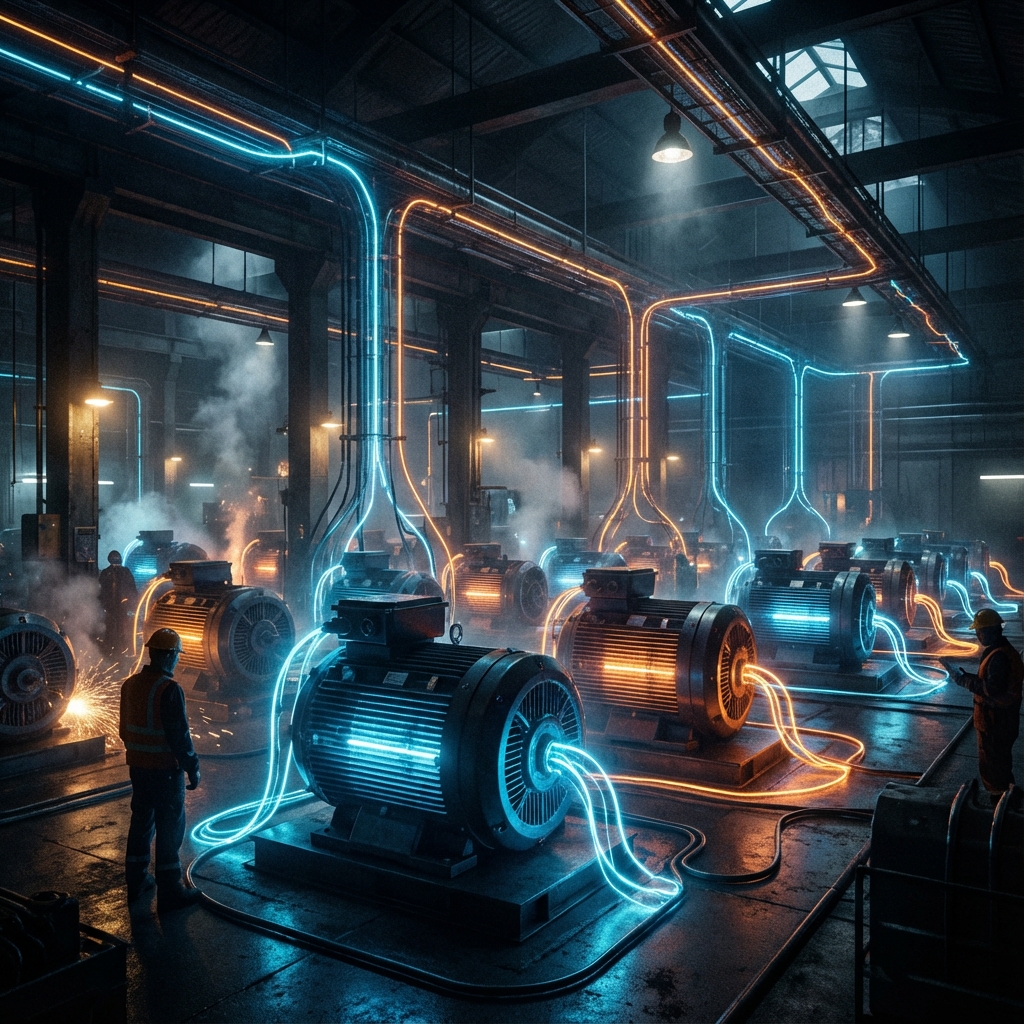
Electric motors are everywhere—from the HVAC system cooling your office to the pumps circulating water in hydroelectric dams. They're so ubiquitous that we rarely think about them. But here's a startling fact that should make every industrial operator pause: electric motor-driven systems account for over 40% of global electricity consumption, making them the single largest end-use of electrical energy on the planet.
To put that in perspective, global electricity demand increased by 1,080 TWh in 2024, and motors alone consume more than 9 trillion kilowatt-hours annually. That's more electricity than the entire combined consumption of Japan, Germany, and the United Kingdom.
Yet despite this massive energy footprint, the industrial motor sector has seen remarkably little innovation over the past 50 years. While smartphones, electric vehicles, and renewable energy have undergone revolutionary transformations, the motors powering our critical infrastructure have largely remained frozen in time—generic, oversized, and inefficient.
The Scale of the Problem
The numbers paint a troubling picture. According to the International Energy Agency, approximately 25% of motor electricity use could be saved cost-effectively, which would reduce total global electricity demand by about 10%. That's not a marginal improvement—it's a transformation that would have profound implications for both operational costs and carbon emissions.
Consider what this means for specific applications:
- Pumps account for 8-9% of global electric energy consumption
- Compressors represent 32% of motor applications
- Fans contribute another 19%
- Industrial machinery drives round-the-clock operations across manufacturing, mining, and processing
Medium-size motors with output powers between 0.75 kW and 375 kW account for about 68% of all electric energy consumed by motors. These are the workhorses of industry—AC induction motors manufactured to standard specifications and ordered from catalogs. They're designed to work everywhere, which means they're optimized for nowhere.
Why Generic Motors Fail Modern Industry
The one-size-fits-all approach made sense in the 1970s when motor applications were simpler and energy was cheap. But today's industrial environment demands precision, efficiency, and adaptability that generic motors simply cannot provide.
Here's what happens when you install a generic motor in a specialized application:
Oversizing and Inefficiency: Generic motors are routinely oversized to handle worst-case scenarios, meaning they operate far below their optimal efficiency point most of the time. An oversized motor doesn't just waste energy—it also experiences increased mechanical stress and shortened lifespan.
Thermal Limitations: Wind turbine motors face extreme temperature fluctuations. Solar tracker motors endure intense heat and dust. Hydropower installations deal with high humidity and corrosion. Generic motors aren't engineered for these specific conditions, leading to premature failure and costly maintenance.
Duty Cycle Mismatch: A motor designed for continuous operation performs poorly when used for frequent starts and stops. Yet generic motors can't be optimized for the specific duty cycles of applications like dam gates, trash-rack rakes, or precision agricultural systems.
Reactive Maintenance: Without built-in intelligence, generic motors offer no visibility into their own health. Operators are flying blind until something fails—usually at the worst possible time.
The Case for Application-Specific Design
The alternative to this inefficiency is purpose-built motor systems designed around the specific demands of each application. This isn't just about tweaking specifications—it's a fundamental reimagining of what motors can do when designed with deep knowledge of their operating environment.
At Smartricity, we've seen transformative results from application-specific approaches:
Energy Efficiency Gains: By selecting the optimal motor architecture—whether Synchronous Reluctance, Switched Reluctance, or Axial Flux—and tuning it precisely to the application, we consistently achieve 10% or greater improvements in energy efficiency. Across thousands of operating hours, this translates to substantial cost savings and emissions reductions.
Physical Optimization: Application-specific design allows for dramatic reductions in motor weight and size—up to 50% in some cases. This isn't just about saving space; smaller, lighter motors reduce structural loads, simplify installation, and lower transportation costs.
Reliability Improvements: When motors are engineered for their specific environment—with appropriate thermal management, environmental sealing, and protection against application-specific hazards—uptime increases dramatically. We routinely see 30%+ improvements in system availability.
Intelligent Operation: Integrating AI-powered software turns motors from dumb mechanical devices into intelligent systems that adapt in real-time, predict maintenance needs, and continuously optimize their own performance.
The AI Advantage
The convergence of advanced motor design and artificial intelligence represents a paradigm shift. Modern motor systems can now:
- Adapt Dynamically: Real-time algorithms adjust motor parameters based on load conditions, optimizing efficiency moment by moment
- Predict Failures: Vibration analysis, thermal monitoring, and current signature analysis detect anomalies weeks before catastrophic failures
- Learn and Improve: Machine learning models continuously refine control strategies based on operational data, improving performance over time
- Provide Transparency: Comprehensive data visibility allows operators to make informed decisions about maintenance, energy management, and system optimization
This isn't futuristic technology—it's available today and already deployed in renewable energy installations, vertical farming operations, and critical infrastructure worldwide.
The Economic Reality
Here's the uncomfortable question every facility manager should ask: How much money are we leaving on the table by not modernizing our motor systems?
For a mid-sized industrial facility consuming 10 million kWh annually for motor-driven systems (a realistic figure for many manufacturing plants), a 10% efficiency improvement saves 1 million kWh per year. At industrial electricity rates of $0.08-0.12/kWh, that's $80,000-$120,000 in annual savings—every year, for the life of the equipment.
Add in reduced downtime, extended equipment life, and lower maintenance costs, and the return on investment for application-specific motors becomes compelling. The payback period for well-designed motor upgrades typically ranges from 2-5 years, depending on the application and operating conditions.
The Path Forward
The transition to application-specific, intelligent motor systems isn't just an operational improvement—it's an environmental imperative. Improving electric motor efficiency by just 1% would save 0.10 petawatt-hours annually—enough electricity for more than 8 million homes in the USA.
As global electricity demand continues to accelerate—projected to increase by 4.5% in 2025 and at least 2.8% annually through 2030—the inefficiency of legacy motor systems becomes increasingly untenable. Every kilowatt-hour wasted represents both unnecessary costs and avoidable carbon emissions.
The technology exists today to address this massive energy drain. Application-specific motor designs, coupled with AI-driven optimization, offer a proven path to dramatic efficiency improvements. The question isn't technical feasibility—it's institutional willingness to challenge the status quo.
For industrial operators, renewable energy developers, and infrastructure managers, the calculus is clear: motors represent the single largest opportunity to reduce energy consumption, lower operating costs, and decrease environmental impact. The hidden energy drain is no longer hidden—and there's no excuse for ignoring it.
The future of industrial motors isn't about incremental improvements to generic designs. It's about purpose-built solutions that match the precision of modern engineering to the specific demands of each application. That future is available now—and it's transforming how the world thinks about electric motors.