
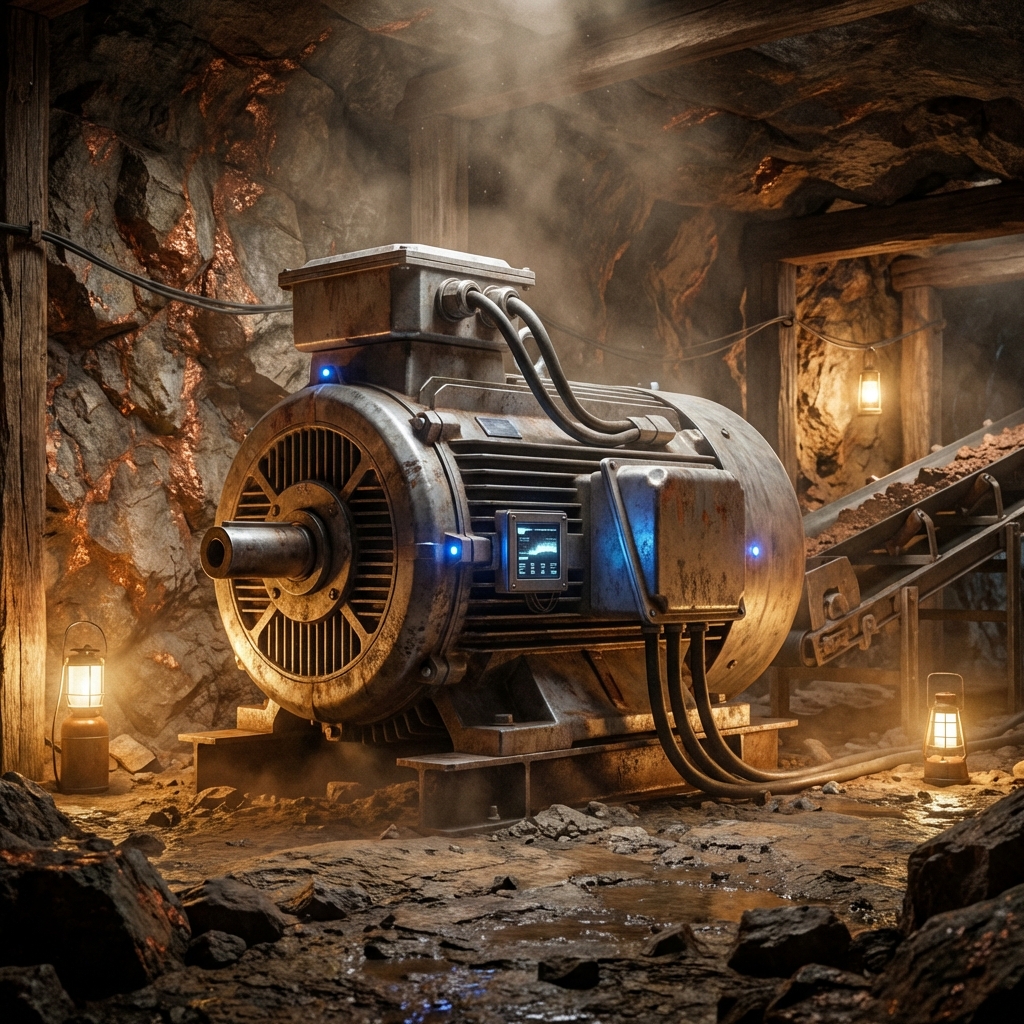
Consider a crushing motor operating 2,000 feet underground in a hard-rock mine. Ambient temperatures hover near 110°F. Fine dust penetrates every seal. Crushing operations create constant vibration. Humidity swings from bone-dry to near-saturated as ventilation varies. Conventional equipment would fail within months under these conditions.
A purpose-built intelligent motor does more than survive in that environment — it thrives. Not because it's a generic industrial motor adapted for mining, but because it's engineered from the ground up for this duty cycle, continuously monitoring its own health, adapting to conditions, and signalling failures before they occur.
This is Mining 4.0: the convergence of advanced motor design, artificial intelligence, Industrial IoT, and automation transforming one of humanity's oldest and most dangerous industries into a showcase of modern efficiency and safety.
The Mining Challenge
Mining operations face unique operational and safety challenges:
Extreme Environmental Conditions
Temperature Extremes: Underground mines can range from near-freezing in some regions to 130°F+ in deep South African gold mines. Equipment must function reliably across this range.
Dust and Contamination: Fine rock dust penetrates seals, abrades surfaces, and infiltrates electronics. Airborne particles create explosive atmospheres in coal mining.
Moisture and Corrosion: High humidity, water ingress from seepage or process operations, and corrosive minerals accelerate equipment degradation.
Vibration and Shock: Crushing, drilling, and blasting operations create punishing vibration and mechanical shock loads.
Operational Intensity
24/7 Operation: Mines run continuously. Downtime directly impacts production and revenue. A single day of lost production from a high-producing asset can exceed $7 million.
Remote Locations: Many mines operate in isolated areas where accessing specialized repair services is difficult and time-consuming.
Safety-Critical Equipment: Equipment failures don't just cost money—they endanger lives. A hoist motor failure with workers underground, a ventilation fan malfunction, or conveyor collapse can have catastrophic consequences.
Energy Intensity: Mining is among the most energy-intensive industries. Electricity can represent 20-40% of operating costs, making efficiency improvements directly profitable.
Why Generic Motors Fail in Mining
Standard industrial motors weren't designed for mining's brutal conditions:
Thermal Management: Generic motors assume moderate ambient temperatures. In deep underground operations, ambient temperatures can exceed motor design limits, causing premature insulation failure and shortened service life.
Environmental Protection: IP54 or IP55 ratings typical of industrial motors provide inadequate protection against mining's fine dust and moisture, leading to contamination, corrosion, and electrical failures.
Vibration Tolerance: Continuous vibration from crushing and material handling operations accelerates bearing wear and causes mechanical failures not seen in more benign industrial applications.
Reactive Maintenance: Without condition monitoring, failures are discovered only when equipment stops—often at the worst possible time, deep underground or during peak production.
The result: unplanned downtime, expensive emergency repairs, safety risks, and lost production measured in millions of dollars.
Mining 4.0: The Intelligent Alternative
Modern mining operations are embracing Industry 4.0 technologies—AI, IoT, automation, data analytics—to transform efficiency, safety, and profitability. At the heart of this transformation: intelligent motor systems purpose-built for mining's unique challenges.
Application-Specific Design
Mining-grade motors incorporate design features addressing mining-specific conditions:
Enhanced Thermal Management:
- High-temperature insulation systems rated for sustained operation in extreme heat
- Optimized cooling systems maintaining performance in high-ambient conditions
- Thermal monitoring with multiple sensor points tracking winding and bearing temperatures
- Derating algorithms adjusting operating limits based on real-time thermal conditions
Maximum Environmental Protection:
- IP67 or IP68 sealing for submersible-duty applications (pumps, underwater equipment)
- Advanced labyrinth seals and positive pressure systems excluding dust from critical components
- Corrosion-resistant materials and coatings protecting against moisture and chemical exposure
- Specialized gaskets and sealing compounds resistant to mining chemicals and lubricants
Rugged Mechanical Construction:
- Reinforced mounting and housing design withstanding vibration and shock
- Heavy-duty bearings sized for extended life under continuous load and contamination
- Balanced rotors minimizing vibration even under dusty conditions
- Flexible coupling systems isolating motors from shaft misalignment and mechanical shock
Fail-Safe Features:
- Redundant safety systems for critical applications (hoists, ventilation fans)
- Fail-safe brakes preventing uncontrolled movement during power loss
- Emergency shutdown mechanisms responding to dangerous conditions
- Manual override capabilities allowing safe shutdown during control system failures
Intelligent Monitoring and Control
Beyond mechanical design, Mining 4.0 motors incorporate comprehensive intelligence:
Real-Time Condition Monitoring:
- Vibration sensors tracking bearing health, detecting developing faults weeks before failure
- Thermal monitoring identifying insulation degradation, overloading, and cooling problems
- Current signature analysis revealing electrical and mechanical faults
- Load monitoring ensuring operation within design parameters
Predictive Maintenance:
- AI algorithms learning normal operating patterns for each motor in each specific application
- Anomaly detection identifying deviations from baseline behavior
- Failure prediction forecasting bearing replacement, lubrication service, and component degradation
- Automated alerting notifying maintenance teams of developing problems
Remote Diagnostics:
- Wireless connectivity enabling surface-level monitoring of underground equipment
- Real-time dashboards providing visibility across entire mining operations
- Remote troubleshooting reducing need for underground access
- Fleet-level analytics comparing performance across multiple assets
Adaptive Operation:
- Dynamic adjustment of operating parameters based on load, temperature, and environmental conditions
- Energy optimization reducing power consumption during light-load periods
- Coordinated startup/shutdown sequences minimizing electrical demand spikes
- Integration with mine-wide automation systems
Safety Transformation
The most significant impact of Mining 4.0 motors: dramatically improved safety.
Preventing Catastrophic Failures
Equipment failures underground create immediate safety hazards. A conveyor motor failure can trap workers, a ventilation fan malfunction can create dangerous atmospheres, a hoist motor problem can leave workers stranded.
Predictive maintenance enabled by intelligent motor systems prevents these scenarios by:
Early Detection: Identifying developing problems 4-8 weeks before failure, allowing scheduled interventions during planned maintenance windows rather than emergency situations.
Reduced Underground Access: Remote diagnostics and monitoring minimize the need for technicians to access hazardous underground areas for routine inspections.
Failure Mode Analysis: Understanding how equipment might fail enables engineering controls preventing dangerous situations.
Environmental Monitoring
Mining-grade smart motors contribute to safety through environmental awareness:
Temperature Monitoring: Detecting overheating that could indicate ventilation problems or fire risks
Vibration Analysis: Identifying structural problems or unstable rock conditions affecting equipment mounting
Load Analysis: Detecting blockages, overloading, or abnormal conditions suggesting operational problems
Integration with Safety Systems: Motor data feeds into mine-wide safety monitoring, triggering alarms when anomalies suggest dangerous conditions
Automation Safety
As mining adopts autonomous equipment—remote-controlled loaders, self-driving haul trucks, automated drilling systems—intelligent motors enable safe automation through:
Precise Control: High-performance motor controllers enabling smooth, predictable movements
Position Feedback: Absolute encoders providing exact position information for positioning and safety systems
Redundant Systems: Dual-channel safety architectures ensuring fail-safe operation
Emergency Stop Integration: Immediate response to safety circuit activation
Economic Impact
Safety improvements are compelling enough. But Mining 4.0 motors also deliver substantial financial benefits:
Energy Efficiency
Mining electricity costs are massive. A mid-sized underground operation might consume 200,000+ MWh annually. Motors represent 40-60% of total electrical load.
Application-specific motor design delivers efficiency improvements:
Optimized Architecture: Selecting motor types (Synchronous Reluctance, Permanent Magnet, etc.) matched to duty cycles and loads rather than defaulting to AC induction
Right-Sizing: Eliminating oversized motors operating inefficiently at partial load
Variable Speed Drives: Intelligent control matching motor speed to actual load requirements rather than fixed-speed operation
Load Management: Coordinating motor operation to minimize peak demand charges
For a facility consuming 100,000 MWh annually on motor-driven systems:
- 10% efficiency improvement: 10,000 MWh saved
- At $0.08-0.12/kWh industrial rates: $800,000-$1,200,000 annual savings
- Plus reduced peak demand charges: $100,000-$300,000 additional savings
Annual Total: Over $1 million in energy savings from efficiency alone.
Downtime Reduction
Unplanned downtime is catastrophic in mining. High-producing assets can lose $500,000 to over $7 million per day of lost production.
Predictive maintenance enabled by intelligent motors reduces unplanned downtime by:
Preventing Catastrophic Failures: Early intervention before minor problems become major breakdowns
Optimizing Maintenance Scheduling: Performing maintenance during planned outages rather than emergency shutdowns
Reducing Repair Time: Knowing exactly what failed enables pre-positioning parts and specialized technicians
Extending Service Intervals: Condition-based maintenance rather than conservative time-based schedules
For an operation experiencing 300 hours of motor-related unplanned downtime annually:
- 30% reduction = 90 hours prevented
- At $300,000 average cost per downtime hour: $27 million savings annually
Even for smaller operations, downtime prevention generates millions in value.
Extended Equipment Life
Mining equipment operates in punishing conditions. Generic motors might last 3-5 years before requiring major service or replacement. Purpose-built mining motors with intelligent monitoring routinely achieve 7-10+ year service lives through:
Optimized Operation: Avoiding overloading, thermal stress, and conditions accelerating wear
Timely Intervention: Addressing developing problems before cascading failures cause extensive damage
Proactive Lubrication: Condition-based lubrication preventing both under-lubrication failures and over-lubrication contamination
Duty Cycle Management: Operating within design parameters rather than continuous marginal overloading
Doubling equipment service life from 5 to 10 years cuts capital expenditure in half and reduces downtime associated with major overhauls.
Real-World Implementation
Mining 4.0 isn't theoretical—it's deployed:
Conveyor Systems: Intelligent motors on belt conveyors moving ore from underground to surface optimize energy consumption, detect developing bearing failures, and prevent unplanned stoppages that halt entire operations.
Crushing and Grinding: Variable-speed motors on crushers and mills adapt to ore hardness and throughput, optimizing particle size distribution while minimizing energy consumption.
Ventilation Fans: Mission-critical ventilation systems incorporate redundant intelligent motors with fail-safe operation, ensuring worker safety even during equipment malfunctions.
Hoists and Elevators: Personnel and material hoists use intelligent motor systems with redundant safety features, continuous condition monitoring, and emergency braking systems.
Pumping Systems: Underground water management relies on intelligent pumps with submersible-rated motors, remote monitoring, and predictive maintenance preventing flooding.
Mobile Equipment: Autonomous haul trucks, loaders, and drilling systems use precision motor control enabling remote and automated operation.
The Integration Challenge
Implementing Mining 4.0 motor systems requires more than purchasing smart equipment:
Infrastructure: Wireless networks providing connectivity in underground environments (leaky feeder systems, mesh networks, or emerging 5G solutions)
Data Management: Platforms aggregating data from hundreds of motors across multiple mine sites, performing analytics, and presenting actionable insights
Skills Development: Training maintenance teams to interpret AI-generated diagnostics and work with data-driven maintenance strategies
Cultural Change: Transitioning from reactive maintenance cultures to predictive, data-driven approaches
Integration: Connecting motor systems with existing mine management platforms, safety systems, and automation infrastructure
Organizations succeeding at Mining 4.0 implementation address these challenges systematically, treating intelligent motor deployment as strategic transformation rather than equipment replacement.
The Mining Future
Global mining production must increase substantially to support energy transition. Copper demand for electrification, lithium for batteries, rare earths for renewable energy—all require expanded mining operations.
This expansion must occur while:
- Improving worker safety and reducing fatalities
- Reducing environmental impact and water consumption
- Lowering carbon emissions from mining operations
- Operating profitably despite higher labor and energy costs
Mining 4.0 technologies, particularly intelligent motor systems, enable this challenging combination. They deliver:
Safety: Predictive systems preventing catastrophic failures that endanger workers
Efficiency: Optimized operations reducing energy consumption and maximizing productivity
Sustainability: Lower energy use translating to reduced carbon emissions
Profitability: Reduced downtime and operating costs improving margins even as resource grades decline
Transforming the World's Toughest Industry
Mining has always been among humanity's most challenging industrial endeavors—extracting resources from deep underground in hostile environments while managing immense safety and environmental responsibilities.
Mining 4.0, powered by intelligent motor systems, is transforming this ancient industry. The same motors that once required three workers with wrenches and experience to maintain now monitor themselves, predict their own failures, and optimize their own operation—all while operating in conditions that would quickly destroy conventional equipment.
The future of mining isn't just autonomous trucks and remote operations. It's intelligent infrastructure—motors that don't fail, systems that optimize themselves, and operations where safety and profitability reinforce rather than conflict. That future is being built today, one smart motor at a time, deep underground where it matters most.