
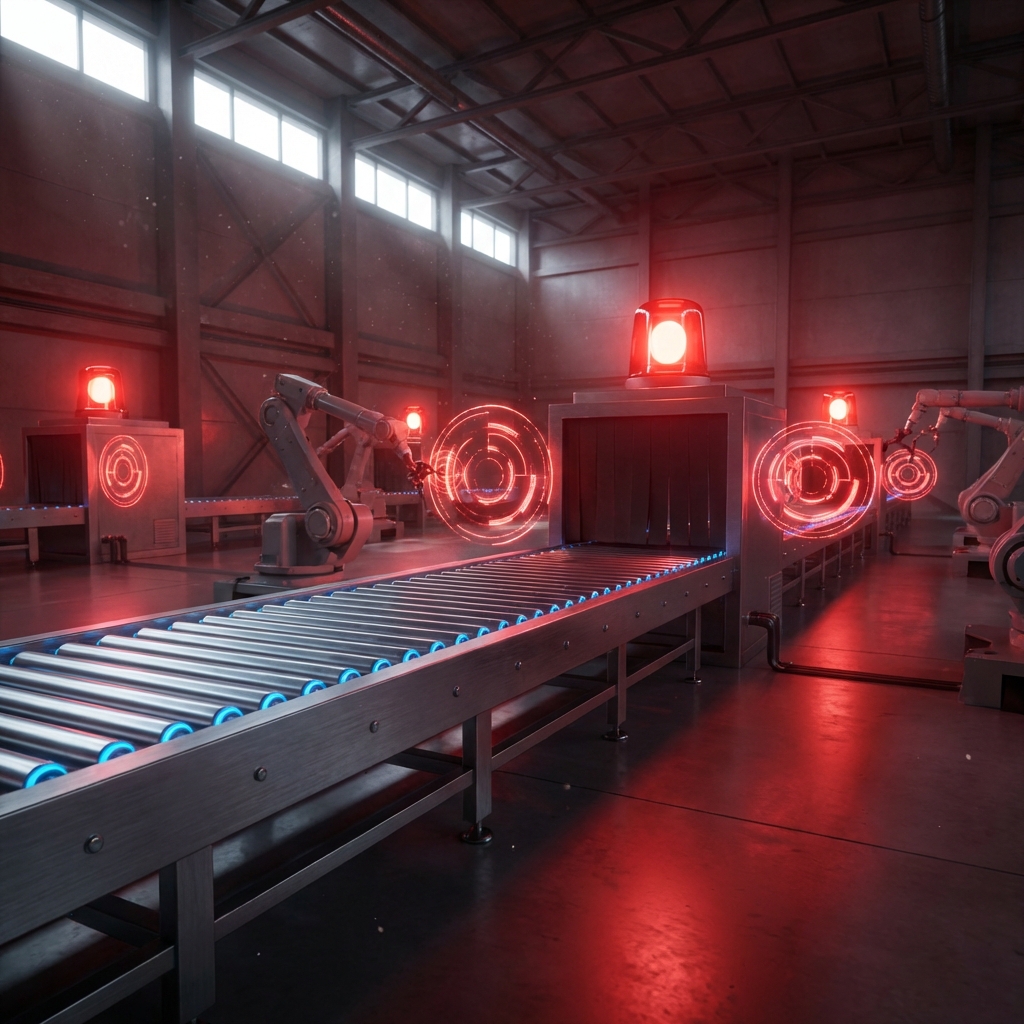
Picture a scenario familiar to operations leaders across industry: in the early hours of the morning, a bearing fails in a critical motor driving a conveyor system that feeds a stamping line. Within minutes, the entire production line grinds to a halt.
The direct cost of replacement parts: a few thousand dollars.
The actual cost of the incident, once lost production, customer penalties, and recovery labor
are tallied: hundreds of thousands — sometimes more than a million.
Variations of this scenario repeat thousands of times daily across industrial facilities worldwide. Equipment fails, production stops, and costs spiral. Yet most organizations dramatically underestimate the true financial impact of downtime—focusing on repair costs while ignoring the cascading effects that multiply the damage.
As of 2026, the cost of unplanned downtime has reached unprecedented levels. Understanding these costs—and more importantly, implementing strategies to prevent them—has become essential for industrial competitiveness.
The Anatomy of Downtime Costs
When operators calculate downtime costs, they typically focus on obvious, immediate expenses: emergency repair costs, replacement parts, and overtime labor. These "above the line" costs are easy to quantify but represent only a fraction of true economic impact.
The complete financial burden includes four distinct categories:
1. Direct Production Losses
The most visible cost is lost production. For manufacturing facilities operating on thin margins, every hour of stopped production directly impacts the bottom line.
According to Siemens' 2024 research, unplanned downtime costs manufacturers $39,000-$2.3 million per hour depending on industry. More specifically:
- Automotive Manufacturing: $2.3 million per hour—approximately $600 per second
- Heavy Industry: $59 million in annual losses from unplanned outages
- Semiconductor Fabrication: Over $1 million per hour
- Food and Beverage: $100,000-$250,000 per hour
- Mining Operations: A single day of lost production from a high-producing offshore asset can exceed $7 million
These figures aren't theoretical. ABB surveyed more than 3,200 global plant maintenance leaders and found that two-thirds of companies dealt with unplanned downtime at least once a month, at a cost of $125,000 per hour.
2. Recovery and Repair Costs
Emergency repairs command premium pricing. Expedited shipping, after-hours labor, and contractor call-outs can triple normal maintenance costs. But the economic impact extends beyond immediate repair expenses:
- Engineering Resources: Troubleshooting and root cause analysis consume technical staff time
- Spare Parts Inventory: Emergency repairs deplete critical spare parts, requiring expensive replacement
- Quality Issues: Rushed repairs increase the likelihood of recurring failures
- Certification and Testing: Getting equipment back online safely requires inspection and validation
3. Supply Chain Disruption
Modern manufacturing operates on just-in-time principles with minimal buffer inventory. When production stops, the impact radiates outward:
- Customer Penalties: Late delivery penalties and contract violations
- Lost Sales: Customers source from competitors, potentially permanently
- Expedited Shipping: Rush logistics to meet commitments
- Downstream Impact: Halt in supply affects customers' production schedules
For automotive tier-1 suppliers, a single day of downtime can trigger production stops at OEM assembly plants, leading to penalty charges that dwarf the original failure cost.
4. Hidden Operational Costs
The least visible but most insidious costs arise from operational disruption:
- Labor Inefficiency: Production workers standing idle still accrue wages
- Startup Waste: Materials wasted during shutdown and restart sequences
- Energy Losses: Maintaining temperature, pressure, or environmental controls during downtime without productive output
- Deferred Maintenance: Resources diverted to emergency repairs delay planned maintenance, creating future failure risk
- Reputation Damage: Unreliable suppliers lose preferred vendor status and future business
According to recent industry surveys, business disruption accounts for a whopping 35% of total downtime costs—more than double the direct repair expenses.
Why Downtime Costs Are Accelerating
If downtime is so expensive, why hasn't the problem been solved? The uncomfortable reality is that despite decades of technological advancement, unplanned downtime costs are actually increasing.
Siemens research found that unplanned downtime now consumes 11% of annual revenues from the world's 500 biggest companies—$1.4 trillion globally, up from $864 billion (8% of revenues) in 2019-20.
Several factors drive this troubling trend:
Equipment Complexity
Modern machines have more controllers, sensors, and software than ever—and more ways to fail. A traditional motor might have a dozen failure modes; an intelligent motor system with integrated controls, sensors, and communication interfaces has hundreds. When failures occur, diagnosis takes longer because you might need a specialist who isn't available until Thursday. Generic motor systems provide no diagnostic data, forcing technicians to troubleshoot blind.
Supply Chain Fragility
Global supply chains, stressed by pandemic disruptions and geopolitical tensions, have become less resilient. Lead times for critical components have extended from weeks to months. Facilities that once maintained comprehensive spare parts inventories now operate lean, trading capital costs for availability risk. When a critical motor fails and the replacement won't arrive for eight weeks, the financial impact is catastrophic.
Aging Infrastructure
Capital investment was deferred during COVID, and again during supply chain chaos, and now there's a backlog of maintenance coming due all at once. Much of the installed base of industrial motors dates from the 1990s or earlier—equipment that has exceeded its design life but continues operating because replacement is expensive and disruptive. This aging infrastructure creates a ticking time bomb of deferred failures.
Rising Input Costs
Energy prices, labor rates, and materials costs have all increased substantially. According to Siemens, an hour of downtime costs significantly more than it did two years ago—driven by inflation, higher energy costs, and supply chain complexity.
The Hidden Costs Multiply
Return to the hypothetical scenario introduced earlier. On paper the repair is modest: a few thousand dollars in parts plus roughly a day of service labor. The headline invoice might total under $5,000.
But if the production line is down for 14 hours — spanning two shifts — the real cost accumulates across several categories:
- Lost Production: 14 hours of halted output on a line producing ~320 parts/hour at ~$185 gross profit per part — on the order of $800,000
- Labor Inefficiency: Dozens of production workers idle during the outage — typically $10,000+
- Emergency Service: Technician call-out, expedited parts, contractor support — often $5,000–$15,000
- Downstream Impact: Penalty charges from downstream customers for missed deliveries — frequently $20,000+
- Quality Waste: Scrapped parts produced during restart — often $5,000–$10,000
- Typical total impact: well north of $800,000 — hundreds of times the headline repair cost
In a case like this, the repair itself represents a fraction of a percent of the total cost. The rest comes from cascading operational and business impacts.
This isn't an extreme example — it's typical. Facilities face significant financial exposure from even minor equipment failures.
The Paradox of Improvement
Here's an encouraging statistic: major manufacturers have reduced downtime from an average of 42 incidents per month in 2019 to 25 incidents in 2024. Companies are getting better at prevention.
But here's the paradox: while incident frequency has decreased, average downtime per incident has increased—taking longer to diagnose issues and restore operations. Why? Equipment complexity, supply chain challenges, and specialized knowledge requirements mean that when failures do occur, recovery takes longer. The industry is preventing more small failures but struggling with the big ones.
The Path to Prevention
The astronomical cost of downtime makes the business case for preventive strategies compelling. Even modest improvements in reliability generate substantial ROI.
Consider a facility experiencing 400 hours of unplanned motor-related downtime annually at an average cost of $125,000 per hour. That's $50 million in annual downtime losses. A 30% reduction—achievable through predictive maintenance and application-specific motor systems—saves $15 million per year. Against this backdrop, investments in intelligent motor systems, condition monitoring, and predictive analytics look less like costs and more like bargains.
Modern Prevention Strategies
The transition from reactive to proactive maintenance isn't just philosophical—it's technological. Modern approaches to downtime prevention include:
Predictive Maintenance
AI-powered predictive maintenance is now called a "must-have" technology, with the potential to reduce the need for replacement parts by up to 40%. Rather than responding to failures or maintaining fixed schedules, predictive systems use real-time data to identify problems before they cause downtime.
Key capabilities include:
- Vibration analysis detecting bearing wear
- Thermal imaging identifying hot spots and insulation degradation
- Current signature analysis revealing mechanical and electrical faults
- Oil analysis monitoring lubricant condition and contamination
These technologies can identify impending failures weeks or months in advance, enabling planned maintenance during scheduled downtime rather than emergency repairs during production hours.
Intelligent Motor Systems
Application-specific motors with integrated sensors and embedded intelligence provide unprecedented visibility into equipment health. Rather than treating motors as black boxes, operators gain real-time insight into:
- Operating efficiency and power quality
- Thermal stress and load conditions
- Vibration signatures and bearing health
- Environmental conditions and contamination ingress
This intelligence enables data-driven maintenance decisions and early intervention before minor issues become catastrophic failures.
Reliability-Centered Design
Perhaps the most effective downtime prevention strategy is to deploy equipment engineered for reliability in the first place. Application-specific motors designed for their actual operating environment—with appropriate thermal management, environmental protection, and duty cycle optimization—experience dramatically lower failure rates than generic alternatives. When a motor is purpose-built for wind turbine operation with corrosion-resistant materials, advanced environmental sealing, and thermal design matched to nacelle conditions, it doesn't fail prematurely from environmental stress. The upfront engineering investment is repaid many times over through extended service life and avoided downtime.
The Business Case Is Clear
The economics of downtime prevention are straightforward: modest investments in intelligent systems and purpose-built equipment generate massive returns through avoided disruption. For a facility facing $50 million in annual downtime losses, even a $5 million investment in motor system upgrades and predictive maintenance infrastructure offers a one-year payback if it achieves a 10% reduction in downtime. More aggressive prevention strategies targeting 30-50% reductions provide IRRs exceeding 100%.
Yet many facilities continue operating reactive maintenance strategies, responding to failures rather than preventing them. The primary barrier isn't technical or financial—it's institutional inertia and the challenge of justifying upfront investment against uncertain future benefits.
Changing the Equation
As downtime costs continue to escalate, the risk calculus shifts. What was once an acceptable trade-off—low upfront investment in exchange for occasional failures—becomes untenable when each failure costs hundreds of thousands or millions of dollars. Forward-thinking operators are embracing this reality. They're investing in:
- Intelligent Equipment: Application-specific motor systems with built-in diagnostics and predictive capabilities
- Condition Monitoring: Real-time visibility into equipment health across critical assets
- Data Analytics: AI-driven analysis identifying patterns and predicting failures
- Reliability Engineering: Purpose-built equipment designed for actual operating conditions
These strategies aren't eliminating downtime entirely—some failures are inevitable. But they're dramatically reducing the frequency and duration of unplanned outages, translating directly to improved profitability and operational resilience.
The Hour You Can't Afford
Every industrial facility has critical equipment—motors, drives, control systems, process equipment—whose failure triggers production stops. For each piece of equipment, there's a number: the cost of an hour of downtime. For some facilities, it's $25,000. For others, it's $2.3 million. Whatever the number, one truth is universal: unplanned downtime is among the most expensive events in industrial operations.
The question isn't whether to invest in prevention. The question is: what's the cost of not preventing downtime?
Through 2026 and beyond, facilities that treat downtime prevention as a strategic priority—deploying intelligent systems, embracing predictive maintenance, and investing in reliability-centered design—will gain significant competitive advantages over those clinging to reactive approaches.
The most expensive hour in your facility is the next hour of unplanned downtime. What are you doing to prevent it?