
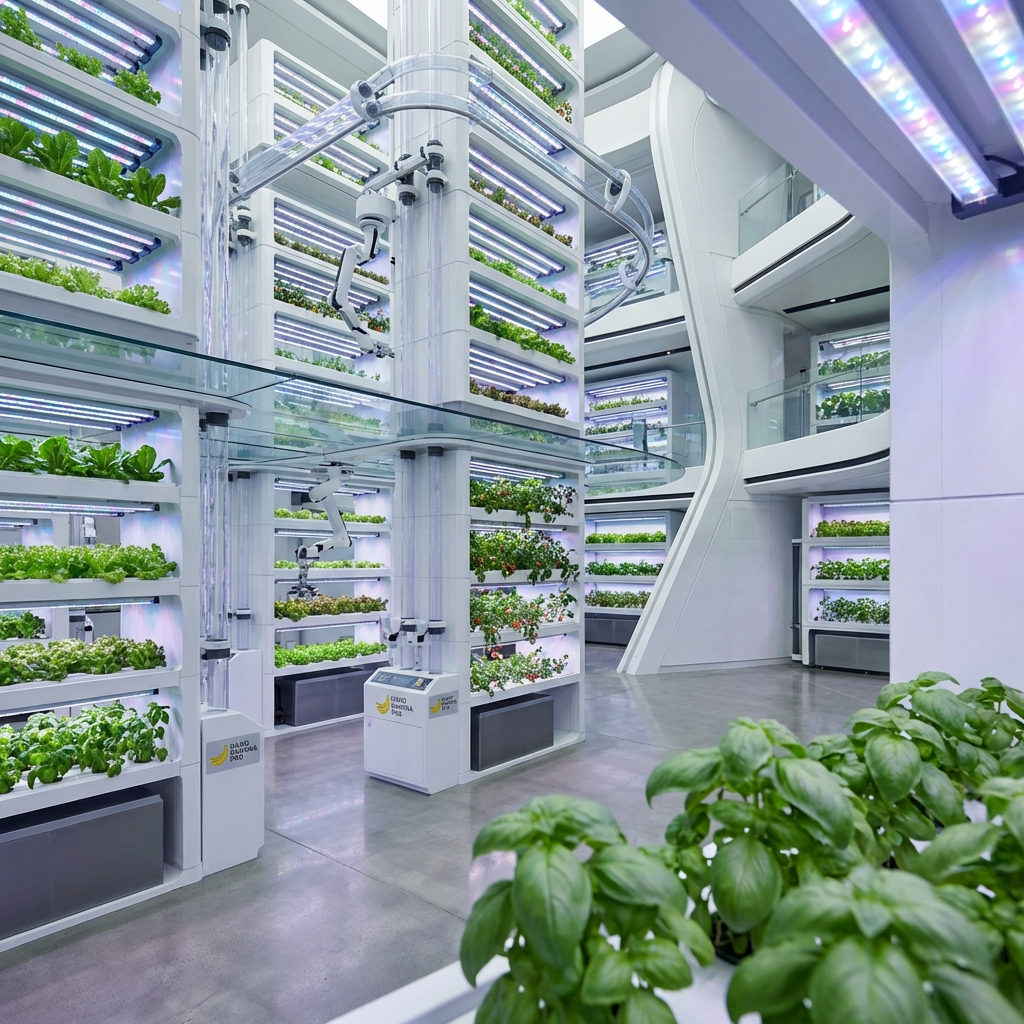
Vertical farming promises a revolution: producing 350 times more food per acre than traditional agriculture, using 95% less water, requiring zero pesticides, and operating year-round regardless of weather. Urban facilities supply local markets, eliminating food miles and delivering produce within hours of harvest.
The technology works. The yields are real. The environmental benefits are substantial.
But here's the uncomfortable question that keeps vertical farming investors awake at night: Can it be profitable?
High-profile failures—including bankruptcies and facility closures—have cast doubt on vertical farming economics. Critics point to high energy costs, expensive infrastructure, and operational complexity. The market has responded with skepticism: despite obvious benefits, vertical farming struggles to achieve mainstream adoption beyond niche applications.
Yet some operations are succeeding spectacularly, generating healthy returns while scaling rapidly. What distinguishes winners from losers isn't growing technique or crop selection—it's infrastructure efficiency.
Specifically: irrigation systems. The difference between profitable and unprofitable vertical farming often comes down to whether operations deploy smart, efficient irrigation infrastructure or struggle with conventional approaches designed for entirely different agricultural paradigms.
The Vertical Farming Value Proposition
Before examining economics, let's establish why vertical farming matters:
Yield Density
A single acre of vertical farming with 10 growing levels produces equivalent output to 350 acres of conventional farmland. This isn't marketing hyperbole—it's simple geometry. Stacking growing areas multiplies production per square foot of real estate.
For expensive urban real estate, this matters enormously. A 50,000 sq ft facility on a $5 million plot can produce yields requiring 1,750 acres—worth hundreds of millions—of conventional farmland.
Water Efficiency
Traditional agriculture consumes 70% of global freshwater. Vertical farms using hydroponic, aeroponic, or aquaponic systems recirculate water, reducing consumption by 95% compared to field agriculture.
This makes food production viable in water-stressed regions and eliminates agricultural runoff—a major source of water pollution.
Year-Round Production
Climate-controlled environments eliminate seasonal limitations. Lettuce, herbs, strawberries—crops typically seasonal or requiring long-distance shipping during off-seasons—can be produced locally, continuously, at consistent quality.
Proximity to Markets
Locating facilities in or near urban centers slashes transportation costs and food waste. Produce delivered within hours of harvest commands premium pricing while offering superior freshness.
Pesticide Elimination
Enclosed environments exclude pests, eliminating pesticide requirements. The result: cleaner, safer produce with longer shelf life and premium market positioning.
The Economic Challenge
Despite these advantages, many vertical farming operations fail financially. Understanding why requires examining the complete cost structure:
Capital Expenditure
Initial facility investment is substantial:
Real Estate: Urban warehouse space in prime
locations: $50-$200 per sq ft
Growing Infrastructure: Vertical racks, growing channels, LED lighting:
$200-$400 per sq ft
Environmental Control: HVAC, humidity control, CO₂ injection: $50-$100 per sq
ft
Irrigation Systems: Conventional approach: $3-$5 per sq ft
Power Infrastructure: Electrical service, distribution, backup: $30-$70 per sq
ft
Automation and Controls: Facility management systems: $20-$50 per sq ft
Total CapEx: $350-$825 per sq ft for a 50,000 sq ft facility = $17.5-$41 million initial investment.
For comparison, a conventional greenhouse might cost $25-$75 per sq ft.
Operating Expenses
Ongoing costs create equal challenges:
Energy: LED lighting, HVAC, irrigation, controls. Typical consumption: 300-500 kWh per sq ft annually. At $0.12/kWh: $36-$60 per sq ft annually.
Labor: Planting, harvesting, system management, quality control. Despite automation, labor remains significant.
Nutrients and Growing Media: Fertilizer solutions, substrate replacement, pH adjustment chemicals.
Maintenance: Equipment service, replacement parts, facility upkeep.
Facility Costs: Rent/mortgage, insurance, utilities beyond electricity.
For a 50,000 sq ft facility, annual operating costs can reach $2-$4 million.
Revenue Realities
Revenue depends on crop selection, yield, and pricing:
High-Value Crops (leafy greens, herbs,
microgreens):
- Yield: 15-25 lbs per sq ft annually
- Price: $3-$8 per lb wholesale
- Revenue: $45-$200 per sq ft annually
Mid-Value Crops (strawberries, tomatoes):
- Yield: 10-20 lbs per sq ft annually
- Price: $2-$5 per lb wholesale
- Revenue: $20-$100 per sq ft annually
For a well-run facility optimizing high-value crops: $75-$125 per sq ft annual revenue is realistic.
50,000 sq ft facility: $3.75-$6.25 million annual revenue.
The Profitability Equation
Revenue: $3.75-$6.25 million
Operating Costs: $2-$4 million
Operating Margin: $1.75-$2.25 million (28-36% margin)
Against $17.5-$41 million capital investment, payback periods extend to 8-18 years—unattractive for investors expecting 4-7 year horizons.
This explains why many operations struggle. Thin margins combined with high capital intensity create challenging economics.
Where Irrigation Systems Make or Break Profitability
Within this cost structure, irrigation infrastructure plays a disproportionate role. It's not the largest line item, but it's the difference between viable and non-viable operations.
Conventional Irrigation Challenges
Traditional vertical farm irrigation follows conventional agricultural models:
Centralized Pumping: Large pumps deliver water to distribution networks with valve-controlled zones.
Manual Control: Operators schedule irrigation cycles based on experience and observation.
Separate Infrastructure: Power and control systems require extensive wiring—hundreds of cable runs for distributed control.
Fixed Operation: Pumps run on fixed schedules regardless of actual plant needs.
This approach creates multiple cost burdens:
Installation Complexity:
- 300 individual control points
- 600 cable runs (power + control)
- Multiple electrical panels
- Complex conduit systems
- Installation cost: $180,000-$250,000
Energy Waste:
- Fixed-schedule operation regardless of plant requirements
- Oversized pumps operating inefficiently at partial load
- Lack of load coordination creating demand spikes
- Energy consumption: 200 MWh annually
- Annual cost at $0.12/kWh: $24,000
Labor Intensity:
- Manual irrigation scheduling
- Daily system adjustments
- Problem identification requiring physical inspection
- Labor requirement: 15-20 hours weekly = $18,000-$25,000 annually
Water Waste:
- Imprecise delivery leading to over-watering
- Runoff and spillage
- Waste: 10-15% of water consumption
Maintenance:
- Complex systems difficult to troubleshoot
- Multiple failure points
- Replacement parts for proprietary systems
Smart PoE Irrigation Advantages
Power-over-Ethernet irrigation systems transform this equation:
Installation Simplicity:
- 300 PoE pumps
- 300 Ethernet cables (single cable per pump, delivering both power and data)
- PoE switches with management
- Network configuration
- Installation cost: $90,000-$130,000
- Savings: $90,000-$120,000 (40-50% reduction)
Energy Efficiency:
- Intelligent on-demand operation
- Low-voltage DC power conversion
- Load coordination preventing demand spikes
- Energy consumption: 120-140 MWh annually (30-40% reduction)
- Annual cost: $14,400-$16,800
- Savings: $7,200-$9,600 annually
Labor Reduction:
- Automated irrigation scheduling based on real-time data
- Remote monitoring and adjustment
- Automated anomaly detection
- Labor requirement: 2-3 hours weekly
- Savings: $15,000-$20,000 annually
Water Optimization:
- Precise delivery matched to plant uptake rates
- Real-time adjustment based on growth stage and environmental conditions
- Waste reduction: 10-15% becomes less than 2%
- Savings: $2,000-$3,000 annually in water costs
Yield Enhancement:
- Optimal hydration improves growth rates 5-10%
- Consistent delivery quality improves crop uniformity
- Revenue impact: $187,500-$625,000 annually on $3.75-$6.25M base
Total Economic Impact
First-Year:
- Infrastructure cost reduction: $90,000-$120,000
- Energy savings: $7,200-$9,600
- Labor savings: $15,000-$20,000
- Water savings: $2,000-$3,000
- Yield improvement revenue: $187,500-$312,500
Total: $301,700-$465,100
Ongoing Annual (years 2+):
- Energy savings: $7,200-$9,600
- Labor savings: $15,000-$20,000
- Water savings: $2,000-$3,000
- Yield improvement revenue: $187,500-$312,500
Total: $211,700-$345,100 annually
Impact on Investment Returns
Returning to the profitability equation with smart irrigation:
Revised CapEx: $17.4-$40.9 million (reduced
infrastructure cost)
Revised OpEx: $1.96-$3.93 million (reduced energy, labor, water)
Revised Revenue: $3.94-$6.56 million (yield improvement)
Operating Margin: $2.0-$2.63 million (33-40% margin)
Payback Period: 7-16 years → improved by 1-2 years
More importantly, the improved operating margin increases facility value substantially. At typical EBITDA multiples of 6-10x for profitable agricultural operations, an additional $200,000-$350,000 in annual operating income adds $1.2-$3.5 million to enterprise value.
Beyond ROI: Operational Excellence
Smart irrigation's benefits extend beyond direct financial metrics:
Data-Driven Optimization
Integrated farm management platforms provide unprecedented visibility:
- Real-time monitoring of every growing position
- Correlation between irrigation patterns and yield outcomes
- A/B testing of growing strategies
- Continuous improvement based on operational data
This intelligence enables continuous optimization impossible with manual systems.
Scalability
PoE infrastructure scales efficiently:
- Adding capacity means installing additional switches and pumps—simple, modular expansion
- Minimal electrical work required
- Consistent management interface across facilities
- Fleet-level learning improving performance across multiple locations
Operators managing multiple facilities achieve economies of scale impossible with conventional infrastructure.
Risk Reduction
Automated monitoring reduces operational risk:
- Early detection of system problems preventing crop loss
- Automated alerts reducing dependence on constant manual oversight
- Data logging proving compliance with food safety requirements
- Remote diagnostics enabling quick response to issues
For investors, reduced operational risk improves project bankability.
Market Trajectory
The vertical farming market is projected to reach $33.02 billion by 2030. But this growth isn't inevitable—it depends on solving the profitability equation.
Operations with efficient infrastructure will thrive. Those burdened by conventional systems will struggle.
Smart irrigation infrastructure is the dividing line. It's not the only factor in vertical farming success, but it's increasingly recognized as essential—the difference between operations that achieve target margins and those that miss by critical percentages.
The Path to Profitability
Vertical farming's promise is real. The technology works. The market exists. Consumer demand for local, pesticide-free produce continues growing.
But promise doesn't equal profit. The vertical farming operations succeeding today are those that:
1. Optimize Infrastructure: Deploy efficient systems like PoE irrigation reducing both capital and operating costs
2. Leverage Data: Use intelligent systems enabling continuous improvement rather than static operations
3. Focus on Margins: Recognize that thin agricultural margins make every efficiency gain critical
4. Scale Intelligently: Expand modularly using proven systems rather than one-off custom infrastructure
Smart irrigation isn't a luxury or a nice-to-have optimization. It's fundamental infrastructure determining whether operations achieve attractive returns or struggle with marginal economics.
The Future of Food Production
As climate change stresses traditional agriculture, as urbanization continues, and as food security concerns grow, vertical farming will transition from niche to mainstream. The question isn't whether vertical farming will succeed—it's which operators will capture the opportunity.
Those armed with efficient infrastructure, intelligent systems, and data-driven operations will build profitable businesses feeding future cities. Those clinging to conventional approaches adapted from outdoor agriculture will continue struggling with the economics.
The difference between vertical farming's promise and vertical farming's profitability isn't technology or technique. It's infrastructure. And smart irrigation is where profitability starts.